Whenever Michelle and I go camping, we enjoy destinations where we can experience solitude and nature. We have canoed on the Churchill River in Northern Saskatchewan, paddling on remote lakes during the day and watching the Northern Lights at night. We have hiked the Skyline Trail in Jasper National Park, a 40 km trek through subalpine meadows and mountain ridges. We have driven our teardrop trailer down the Dempster Highway to Tombstone Territorial Park in the Yukon and camped in the Arctic tundra. We have even camped during the winter in a snow-covered forest. This year we traveled with our trailer to Haida Gwaii to experience camping in a rainforest along the Pacific Ocean.
Haida Gwaii, once known as the Queen Charlotte Islands, is on the west coast of British Columbia. The archipelago is rich in wildlife and old-growth forests and is home to the Haida Nation. The remote islands have only 4200 people spread throughout seven small communities that are reachable either by an eight-hour ferry ride or by air.
We researched Haida Gwaii before our trip, and Agate Beach in Naikoon Provincial Park received raves. Our camping spot would be less than 10 m from the beach, sandwiched between an ancient rainforest and the Pacific Ocean. I couldn’t imagine getting a better experience of camping near the ocean, other than setting up a tent directly on the beach.
Michelle and I planned four days to get to Haida Gwaii: three days of driving to Prince Rupert and one day for the ferry ride to Skidegate. Our trip to Prince Rupert went well, but the morning of our departure to Skidegate got off to a rough start. Michelle woke up feeling dizzy and nauseated, and started vomiting. She’s had episodes of BPPV in the past, where her inner ear crystals get out of position, and movement causes mild to severe vertigo. Her last episode occurred three years ago at home; this episode occurred at the worst possible time: when she was about to embark on an eight-hour ferry trip nicknamed the vomit-comet by some travelers. While Michelle fretted about the ferry ride, I worried about causing an embarrassing delay if our low trailer hitch got stuck on the ship’s loading ramp. We were both very anxious when we arrived at the ferry terminal two hours before our departure.
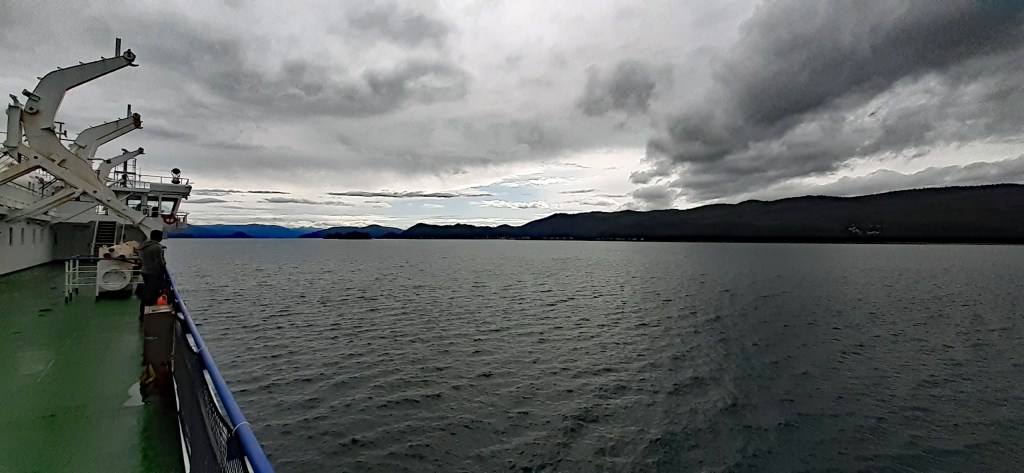
At the ferry terminal, the departure attendant measured our vehicle and trailer and asked if I was comfortable backing it into a parking spot on the ferry. I sheepishly answered no, and he said someone would take over driving once we were on the ferry. When it was our turn to load onto the ferry, just as I feared, the trailer hitch scrapped the loading ramp, bending the support bracket backward. The good news: I didn’t get stuck. After a crew member expertly backed our vehicle and trailer into a tight parking spot, Michelle cautiously made her way to the passenger area. She had worried about sitting on uncomfortable chairs in a crowded space but was relieved that the passenger area was large and almost empty, with large comfortable chairs. She settled herself next to a window, and once the Gravol kicked in, slept most of the voyage.
Once the ferry arrived at the terminal in Skidegate, Michelle and I drove directly to the Misty Meadows campground in Naikoon Provincial Park. We wanted to ensure we got a campsite before the Canada Day long weekend and Misty Meadows is the closest public campground to the ferry terminal. When the hitch scraped again, as we drove off the ferry, we didn’t bother inspecting the damage and drove directly to the campground. To our surprise, it was almost empty when we arrived. We were so relieved to set up camp after a stressful day of traveling. Finally, we could begin our adventure in Haida Gwaii!
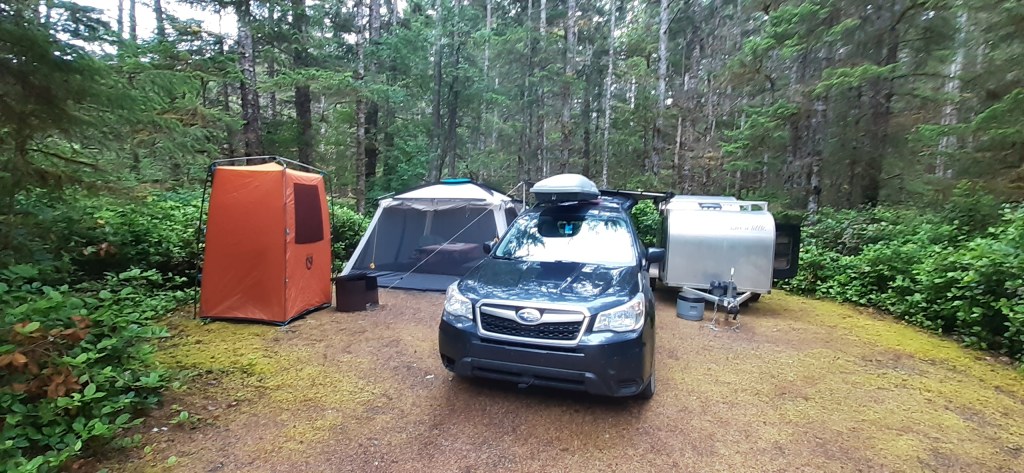
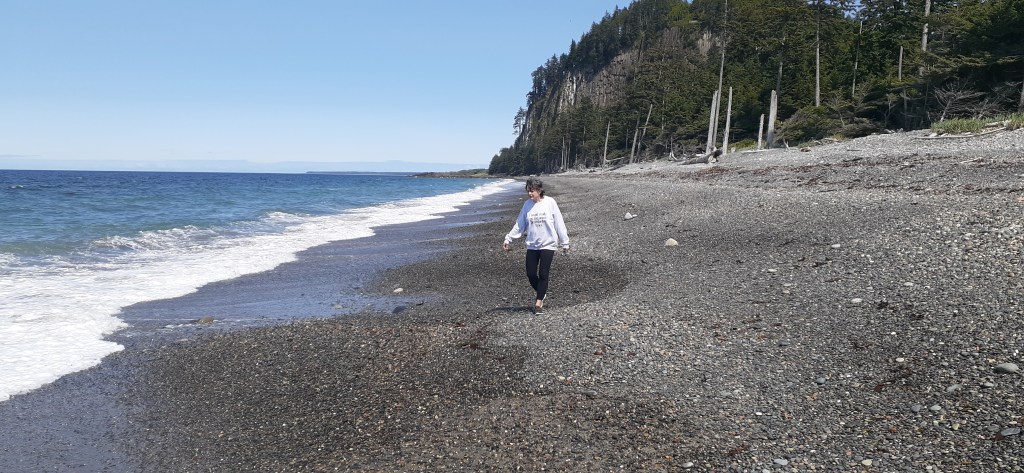
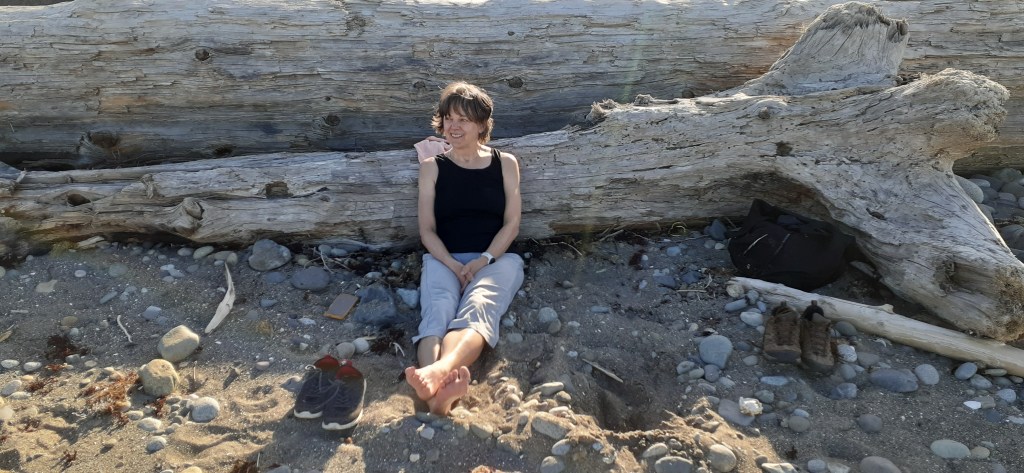
The campground was beautiful, with spruce and hemlock trees rising high above the campground. The sites were private, separated by a dense growth of Salal Berry bushes, dripping wet from a recent shower. Odors of pine and decaying wood permeated the forest. The campground was also quiet except for songbirds singing and the occasional laughter from children playing. Our campsite was a short walk to the beach, which stretched for kilometers in both directions, with huge logs of driftwood, perfect for sitting on. And nobody was there.
We spent the next two days exploring the southern end of Naikoon Provincial Park. We hiked to see the Pesuta shipwreck, a ship that ran aground in 1928 carrying a load of lumber. Michelle and I also hiked the Golden Spruce trail, where an ecoterrorist cut down a 300-year-old, one-of-a-kind golden spruce to protest old-growth logging. It enraged the Haida people because the tree symbolized respecting nature. The authorities charged Grant Hardwin for the malicious act, but he disappeared after paying his bail. (The entire story is in the book “The Golden Spruce” by John Vaillant). On Canada Day we drove to Port Clements and watched a fishing derby for children at the end of a Rainbow Wharf. Everyone was welcoming, wishing us a happy Canada Day and offering us cake and hotdogs while we watched children fishing. We also visited a museum in Daajing Giids to learn about the Haida culture and history and then ate at a local restaurant. I thoroughly enjoyed an enormous bowl of mussels, cooked in a chickpea curry sauce with a pint of beer from a local brewery.

Michelle and I enjoyed our stay at Misty Meadows, but I was eager to camp at Agate Beach. Agate Beach is on the northern end of Naikoon National Park, and we planned to spend our last days there before turning around and driving home. It’s a popular campground, so we waited until after the Canada Day weekend to be sure we could secure a campsite. When we arrived, it shocked us to see the campground was almost full, so we quickly claimed one of the few available sites.
The Agate Beach campground was not what I expected; I was so disappointed after months of anticipation. The beach was stunning, but I found the campground too crowded with sites packed close together. Michelle and I immediately changed our plans to spend two nights at Agate Beach instead of four.

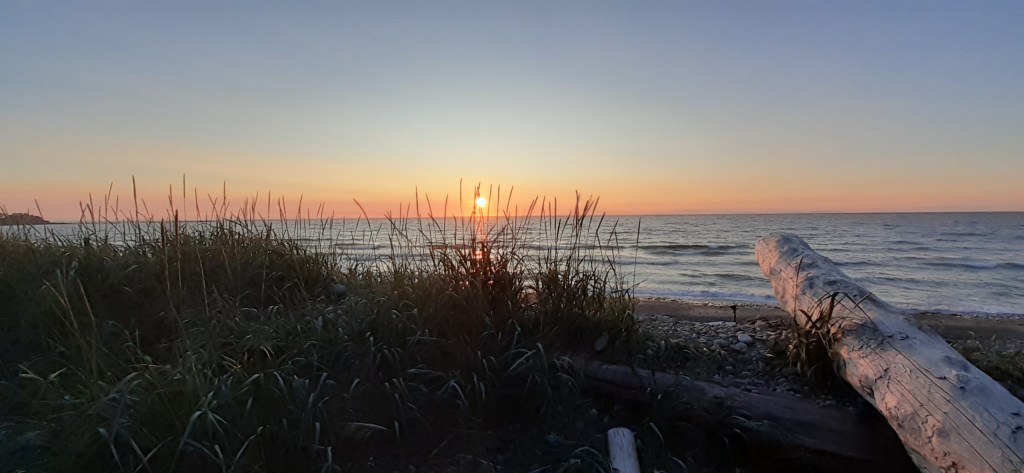
Despite the disappointing campground, we enjoyed camping beside the ocean. I loved the roar of waves crashing against the rocky shore and the salty ocean breeze that made spruce trees grow at an angle. The beach was beautiful, covered with multicolored agates polished smooth by the ocean waves. Michelle and I liked to stroll the beach, picking out the prettiest rocks. We also hiked Tow Hill for a panoramic view of the northern coast of Haida Gwaii. In the evening, we watched campers catch crabs at low tide using fishing nets and the sun setting over the Pacific Ocean. At bedtime, the rhythmic sound of the surf lulled me to sleep.
While camping at Agate Beach, we drove 20 km to the small town of Masset and visited a nature sanctuary run by Margo Hearne and her husband. Margo had raised over a million dollars to replace a road with a bridge into Masset, which revived an estuary by allowing tidewater to flow into a bay. On a viewing platform, she proudly pointed out to us Sandhill Cranes that once again were returning to Massett during the summer. When we left, she gave me a book she had written on songbirds that inhabit Haida Gwaii called “Small Birds Cling to Bare Branches”. Afterward, we stopped for lunch at the 626 Fish and Chipper. If you ever visit Masset, stop there; nothing beats freshly cooked halibut and a plate of fries smothered in ketchup.
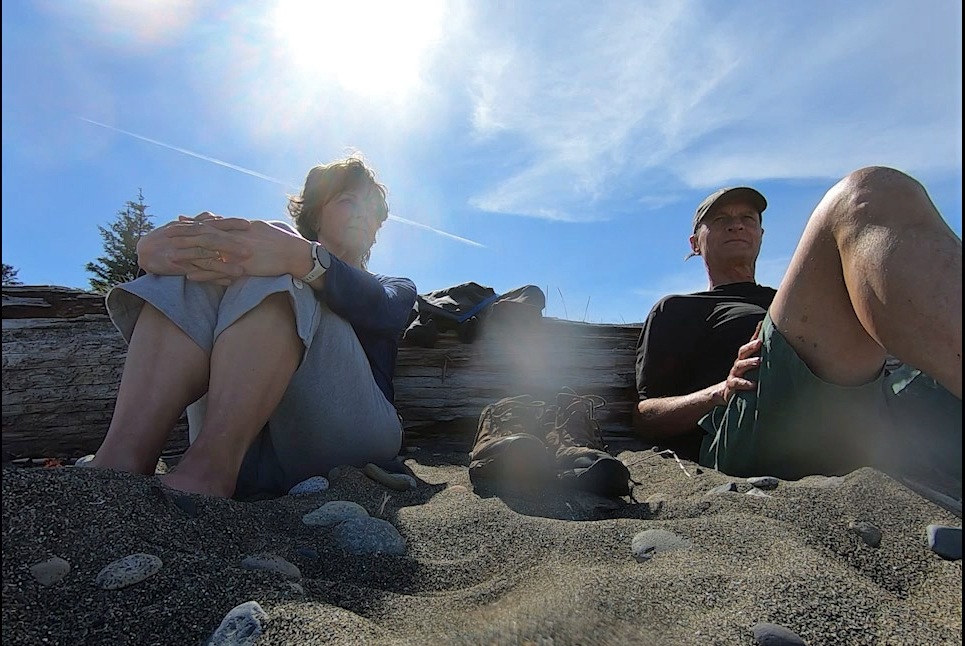
After three days of pounding surf and no privacy, Michelle and I looked forward to returning to the serenity of Misty Meadows’ campground. We spent the last few days reading in the hammock, walking along the beach, and playing Scrabble. I finished the trip as the Scrabble champion, winning all five games. We were sad to leave Haida Gwaii, but we began missing the conveniences of home. We finished our camping trip the evening before our departure, sitting on the beach with a bottle of wine, and watching the waves wash up against the shore. It was the perfect ending to our trip. Nature and solitude at its best.

 One Last Kick