With the Birkenbeiner only a few weeks away, I have completed my last long training ski and can now look forward to finishing up my training with some hill work. Spending over six hours on my skis going around and around on the same trails has gotten monotonous and I am ready for a change. In theory, the long skis were meant to improve my endurance; the next workouts are meant to improve both my cardio and how quickly and efficiently I can ski up hills.
My last long ski did not go well and that has me concerned. After about 40 km, I developed a sharp pain on the bottom of my right foot that was so painful I could barely ski. To make matters worse, I also hit the wall, which made it excruciatingly difficult to finish the last few kilometers. I don’t know if I could have suffered through the agony if I had to ski another 10 kilometers. As a result, my plan during the Birkie is to wear my running orthotics in my ski boots and also stop at the stations along the course where they have a fire lit and food and drink available for the racers. I hope that this will allow me to make it to the finish line without too much difficulty.
Improving my uphill skiing technique will also help during the race. The other week when I was struggling to get up a steep hill, another skier passed me from behind and made it to the top of the hill while I was still only halfway up. As he was blazing up the hill, I saw that he had an instructor with him who was shouting, “Get your butt down!” and “Don’t bob your head!” At that moment I resented him for putting me to shame, but now I realize that he did me a favor: that was the best advice on how to improve my hill-climbing skill.
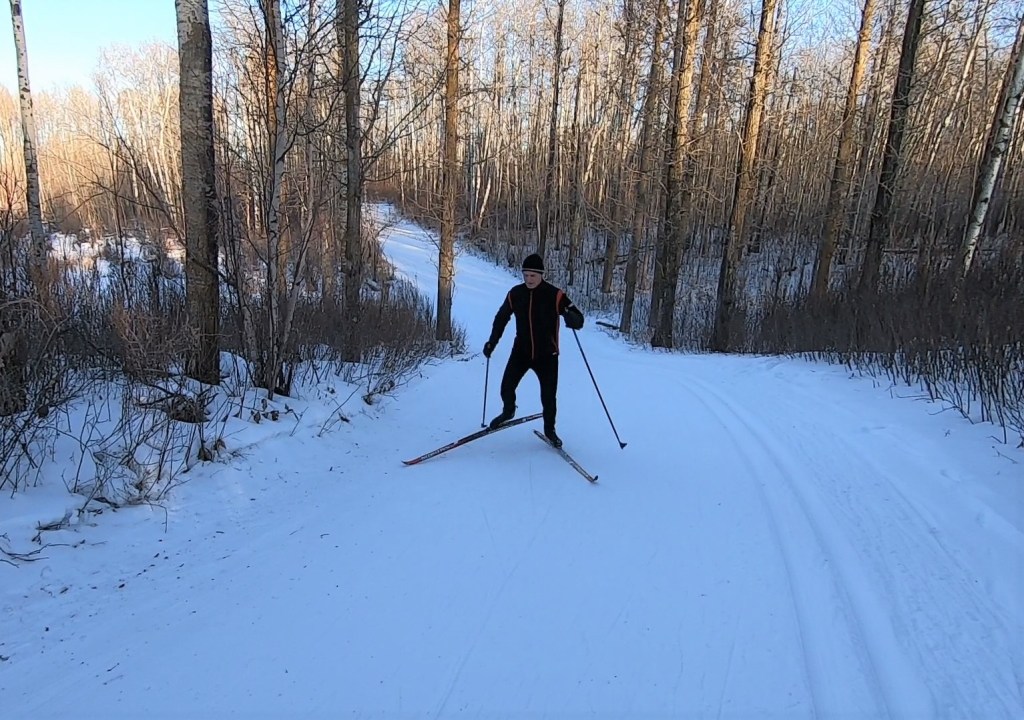
My basic problem with skiing up hills is that I am trying to shuffle my way up, rather than balancing on one ski and bringing the other ski forward to prepare for the next kick. Being able to transfer your weight from one ski to another without losing your momentum is not too difficult on level ground, but on a slippery incline where gravity is pulling you in the wrong direction, it is a difficult skill to master. Too often when I climb hills I use the herringbone technique, and as soon as I have to put my skis at an angle and start stepping up the hill, I lose all momentum and slow my race time. The herringbone technique is also more exhausting. If I can remember to keep my butt down and stop bobbing my head I will be better able to push the camber down on my skis so that the wax can grip the snow and keep me moving forward. This is much more preferable to losing your grip and falling forward and doing a face plant which has happened a few times when I thought I could make it to the top of a hill without losing stride.
Improvements in my hill skiing ability and cardio fitness over the next few weeks will make a huge difference in how well I do at the Birkenbeiner. Like it or not, I will never be as good as the elite skier who passed me–it’s going to take much more than keeping my butt down to ski that fast. I would love to finish under seven hours at the Birkie, but I don’t think that is a realistic goal, especially since my long ski last week did not go well. However, with a few more weeks of training and good weather on the day of the Birkie perhaps I’ll achieve my goal. I am hoping for a nice sunny day that’s not too hot nor too cold. But what I wish for the most is perfect snow conditions and a fast track. Wish me luck.
NB: I found out this week that Birkenbeiner has been canceled due to Covid19 restrictions. That’s not a problem because the organizers were well prepared and have a virtual race planned that I can enter instead. I still get all the joy and agony of skiing 55 km, except I will have to do it on my own and have Michelle support me.

 One Last Kick