When I think about my experience of running the New York City Marathon a few words come to mind. Words like enormous, which describes the size of the race, or words like amazement and worry that describe the emotions that I experienced during the run. Words, however, fail to adequately express my experience of running the world’s largest marathon. It is an experience that can only be fully understood by participating in the race, from the moment you get up early in the morning to get yourself to the start line, until the moment you cross the finish line and make your way back to the hotel room.
The New York City Marathon is the world’s largest marathon, having over 50,000 runners every year, and almost twice as many applicants. Since the marathon is so popular, entrants are mostly chosen through a lottery system. The first race was in 1970 and is held every year on the first Sunday of November. The race has only been canceled twice; once in 2012 due to Hurricane Sandy, and this year due to the COVID-19 pandemic. The race travels through all five boroughs of New York City starting in Staten Island before heading over the Verrazano-Narrows Bridge into Brooklyn. From there the route travels through Queens and then crosses into Manhattan on the 59th Street Bridge. In Manhattan, the course travels down 1st Avenue towards the Bronx, where it turns around and heads back to Manhattan along 5th Avenue. It then passes through Harlem before finishing at Central Park. It is estimated that over 2 million spectators line the route to cheer on the runners as they make their way along the course.
Running a marathon was never a goal of mine, and if it were not for Michelle’s encouragement I would have never entered the lottery. Michelle had already run three marathons–Victoria, Calgary, and Edmonton–before she decided to enter the New York City Marathon. To her excitement, her name was drawn for the 2012 marathon, and then to her disappointment, the marathon was canceled just a few days before the race due to Hurricane Sandy. However, Michelle was guaranteed a spot in one of the next two marathons, so she talked me into entering the 2014 lottery. I was reluctant to enter the race because training for a marathon is a huge time commitment. I was also concerned about getting injured while training and not being able to compete, which would have been a waste of time and money. The odds of getting my name drawn were not good, but to my surprise, my name was drawn. It is very unusual to be lucky enough to have your name drawn the first time you enter the lottery; Michelle and I were both very lucky.
Training for the marathon did not go well for me because, as expected, I injured myself about two and a half months before the race. It was not the kind of injury that I usually get whenever I increase my running volume. Instead of getting tendonitis in my Achilles, I suffered a contusion on the cartilage of my right knee when I stepped awkwardly on a cross country trail. At the time my longest training run was only about 20 kilometers and I needed to be able to increase my distance to about 32 kilometers over the next few weeks. This was a serious injury and I was very concerned it would not heal in time for me to continue training and be able to participate in the race.
Over the next few months, my fears were turning out to be true. I took some time off and waited for the swelling to go down before I tried running again. When I did try going for a run, my knee swelled up, so I took some more time off, only to have it swell up for a second time. This was not good news and I was depressed because it was very likely I would not be able to run the marathon.
After my knee swelled up the second time, I went to a physiotherapist and got the injury diagnosed and treated. After four sessions the physiotherapist was able to reduce the swelling and improve the range of motion in the knee. During this time, I could only train on the elliptical trainer and the stationary bike. There was some hope I would be able to run, but it would not be until the day of the marathon that I would be able to test my knee and my conditioning.
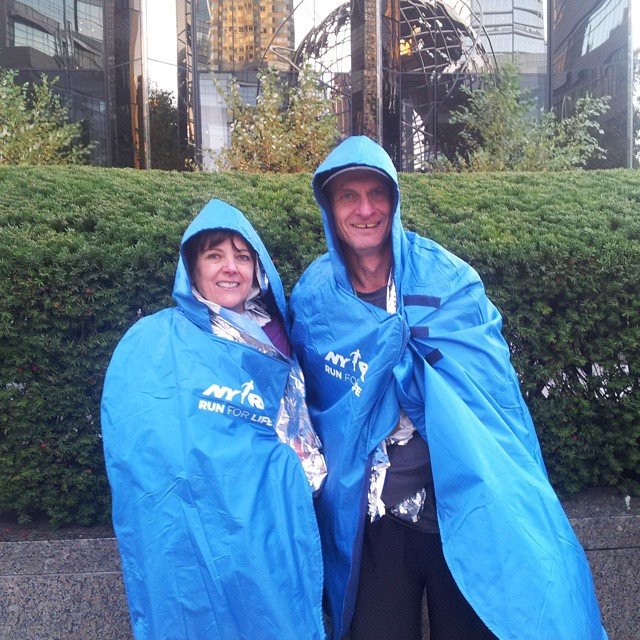
Michelle and I traveled to New York on a Friday and got into our hotel room rather late that night. The hotel was conveniently located near the subway to get to and from the marathon. On Saturday we picked up our race packages and got ourselves prepared to run the next day.
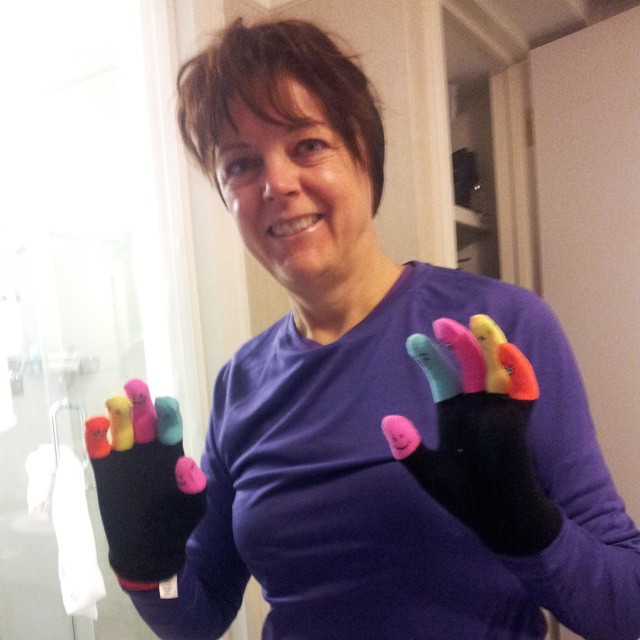
Getting to the start line was not easy. We had to get up at 5:00 am to catch a subway that would get us to the ferry that would take us to Staten Island. Once we reached Staten Island we had to board a bus to Fort Worth, where the start line was located. It took us way longer than expected to get there, arriving only 30 minutes before my start time. I had to quickly find the washroom, say goodbye to Michelle and wish her luck, and then get lined up in my chute for the start of the race. Michelle had a later starting time, so I would not see her again until the finish line. Getting up early and rushing the whole time had me fatigued before the race even started.
Standing at the start line on Verrazano- Narrows Bridge, it finally registered on me that I was about to run the New York City Marathon. I saw thousands of other runners also anxiously waiting to start the race. It was an incredible sight to see all 13 lanes on the double-decker bridge that spans 1.3 kilometers crowded with runners. At that moment I had a burst of energy and was anxious to get the race started.
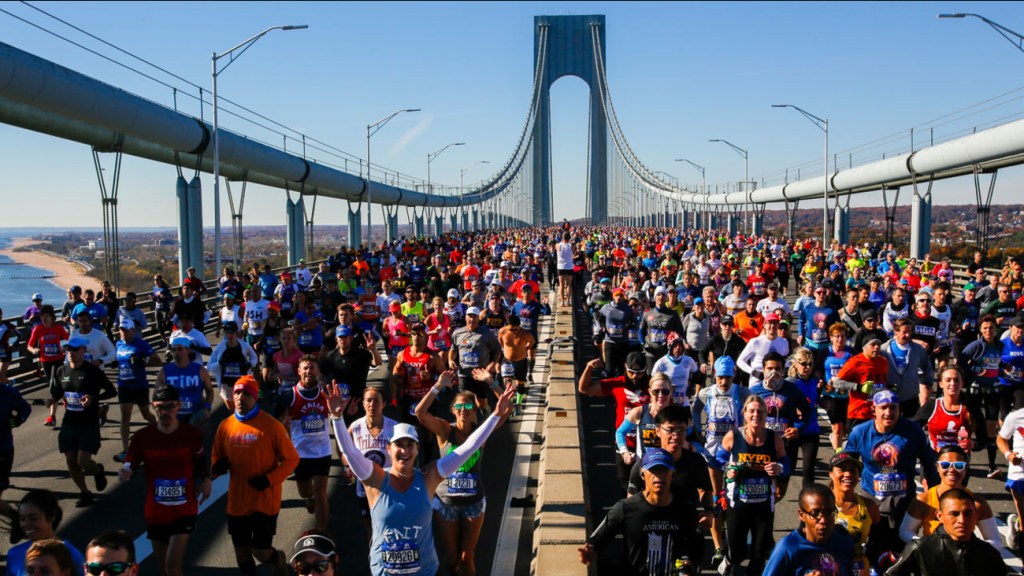
When the race finally started, not only was I anxious, worried about my knee and conditioning, but I was also freezing. The temperature was 4.0 degrees Celsius and there were wind gusts up to 35 km/hr, making it feel even colder. Despite everything I was feeling I was determined to finish the race.
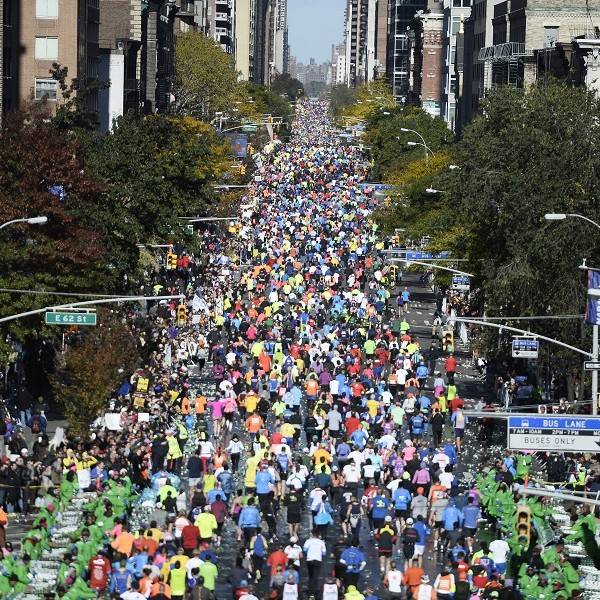
Participating in the race was an unforgettable experience. I still remember entering Manhattan and running down 1st Avenue and seeing the skyscrapers and the tens of thousands of cheering spectators. Ahead of me, I could see thousands of runners heads bobbing up and down as they made their way along the avenue. I could hear spectators shouting encouragement and music blasting everywhere, and the surreal sound of thousands of running shoes hitting the pavement. At this moment of the race, I didn’t feel the pain of having already run 25 kilometers. It was a moment I soaked up and would love to experience again.
After running down 1st Avenue, the last fifteen kilometers were the most difficult part of the race for me. The good news was that my knee was holding up. There was some loss of mobility that affected my stride, but I was confident it could stand up until the finish line. But this is a point in the race when most runners hit the wall, and I definitely hit the wall. What had become apparent after the adrenalin rush of running down 1st avenue wore off, was that I had not trained enough. I was running on fumes.
It is difficult to describe the feeling of when your body has reached the end of its endurance and you have to continue running. This is where the mind games start because you know that if you wanted to, you could just as easily drop out and the pain would stop. You are exhausted, you badly want to stop, and it is only your will that keeps you running. I cracked a couple of times at the water stations and walked further than I would normally, but I was determined to continue running. My pace had dropped off considerably, my running stride had become a shuffle, but I kept going.
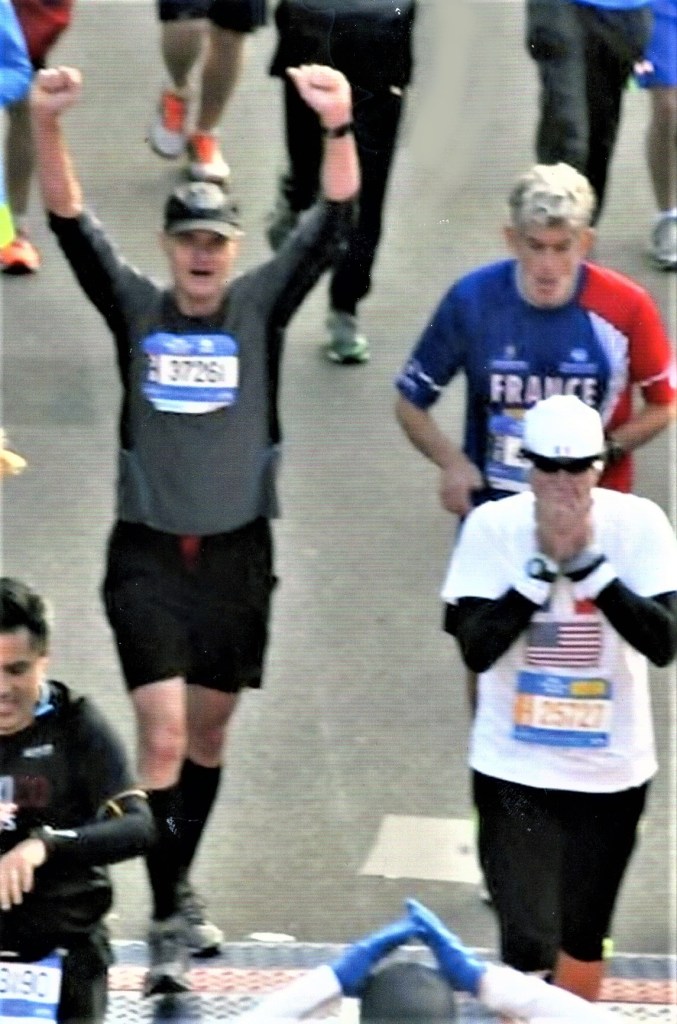
I felt several different emotions when I crossed the finish line. I was happy to get to the end and relieved that I could now stop running. However, I had been thinking about Michelle during the race and began feeling anxious as I waited for her at the finish line. She started later than me, so it seemed like forever before I saw her running towards the finish. It was just as much of a relief to see her cross the finish line as it was for me. We both made it!
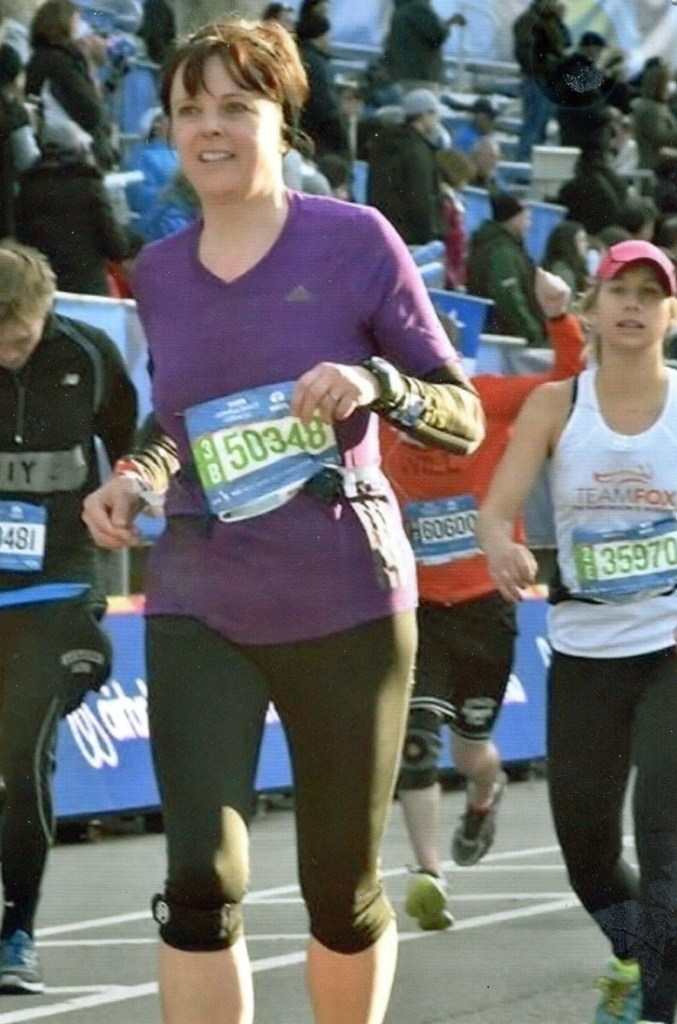
What I remember next about the marathon is walking back to the hotel room. This is not a happy memory because we were both now feeling the after-effects of the race. We were both in pain and could barely walk. We had planned to take the subway back to our hotel until we found that runners could no longer ride for free, like previous marathons and we had not brought any cash. That meant we had a 5-kilometer walk back to our hotel room. Michelle and I had to hold each other up and stop numerous times, as each step was painful. The most painful steps were those going up or down. The relief of getting to the hotel room was more than the relief of finishing the marathon.
I finished with a time of 4:33:32 and placed 27483 in the race. It was remarkable that my average pace was 6:22 per kilometer, considering how much I slowed down over the last 15 kilometers. The time was much slower than the goal I set when I first started training. I was originally disappointed with the result, but given time to think about the circumstances, I am now happy with the result.
Would I like to run the New York Marathon again? Perhaps, but only to experience running in New York. It is not a race you enter if you if want to run a fast time: it is exhausting getting to the start line, you are constantly navigating around other runners, and there are a lot of uphill sections. The Victoria Marathon is much more suited for me to run a faster time than I did at the New York Marathon. New York Marathon, however, was an unbelievable experience for both me and Michelle and one we will never forget.

 One Last Kick